Dutch gas storage has been filled to 41.8 percent so far. Around this time last year it was 61.8 percent, and the level has never been this low in mid-August. On top of that, refilling keeps getting slower rather than faster. This is what that means for the price you pay this winter.

Dutch gas storage has been filled to 41.8 percent so far. The idea is simple: in summer, from April to 1 November, we fill the storage sites at Norg, Grijpskerk and Bergermeer among others, and in winter we use that gas to keep ourselves warm. Around this time last year storage was 61.8 percent full. The level has never been as low in mid-August as it is now.
That is not a number for the statistics. Gas that is not in the ground on 1 November has to be bought on the spot in January, exactly when it is most expensive. The emptier storage goes into winter, the harder a cold week feeds through into the price you pay.
Europe has agreed how full storage must be at the end of the filling season. For the Netherlands that agreement comes down to 74 percent on 1 November. So almost a third of the total capacity still has to go in, with ten weeks left to do it.
How full Dutch gas storage was, this year against last year. In April the gap was sixteen percentage points, now it is twenty. So the gap is growing rather than shrinking.
It is not just the Netherlands running late. Across Europe, storage was 61.1 percent full on 16 August, against 73.6 percent a year earlier. But the Netherlands is further behind than the rest: twenty percentage points below last year, where Europe is twelve below. That is mainly because our two largest storage sites were all but empty after last winter. We started this year further back than our neighbours. If you want to keep an eye on the level yourself: gelijkvergelijk.nl has an overview of Dutch and European gas storage that is updated daily.
Less strict than it sounds. There is give in the date and in the percentage, and last year the Netherlands ended 1 November at 73 percent, so just short of the target then too. No fine is waiting. But that is not the point either. The point is how much gas is in the ground when it freezes for two weeks straight in January, and what you pay for the gas that has to be bought at a moment like that.
You would expect filling to be at full tilt now, with winter in sight. The opposite is happening. Every week less goes in than the week before. In the past week, the amount added per day was roughly two thirds of what would be needed to reach that 74 percent in time.
How much gas was added per week, averaged per day, in gigawatt hours. The dotted line is what has to go in every day from now on to reach 74 percent on 1 November. Recent weeks sit below it.
Extend that line and you know where this ends. At the pace of the past two weeks, the counter will be at around 64 percent on 1 November. At the pace of the past month it becomes 67 percent. And even if from tomorrow it goes like the best week of this year, in mid-June, the Netherlands ends up at about 76 percent. That is how small the margin is: reaching 74 percent is only possible if it goes for ten weeks straight the way it went for just one week this year.
Not because it cannot be done. The storage sites can take in almost two and a half times as much gas per day as would be needed now. So no pump is standing idle because it cannot cope.
It comes down to money. Gas you buy today is more expensive than gas for delivery this winter. Whoever buys now, puts it in the ground and takes it out again in January, sells it for less than they paid for it. Filling is then no longer smart preparation but a loss-maker, and so it happens slowly. That is exactly what you see in the weekly figures above.
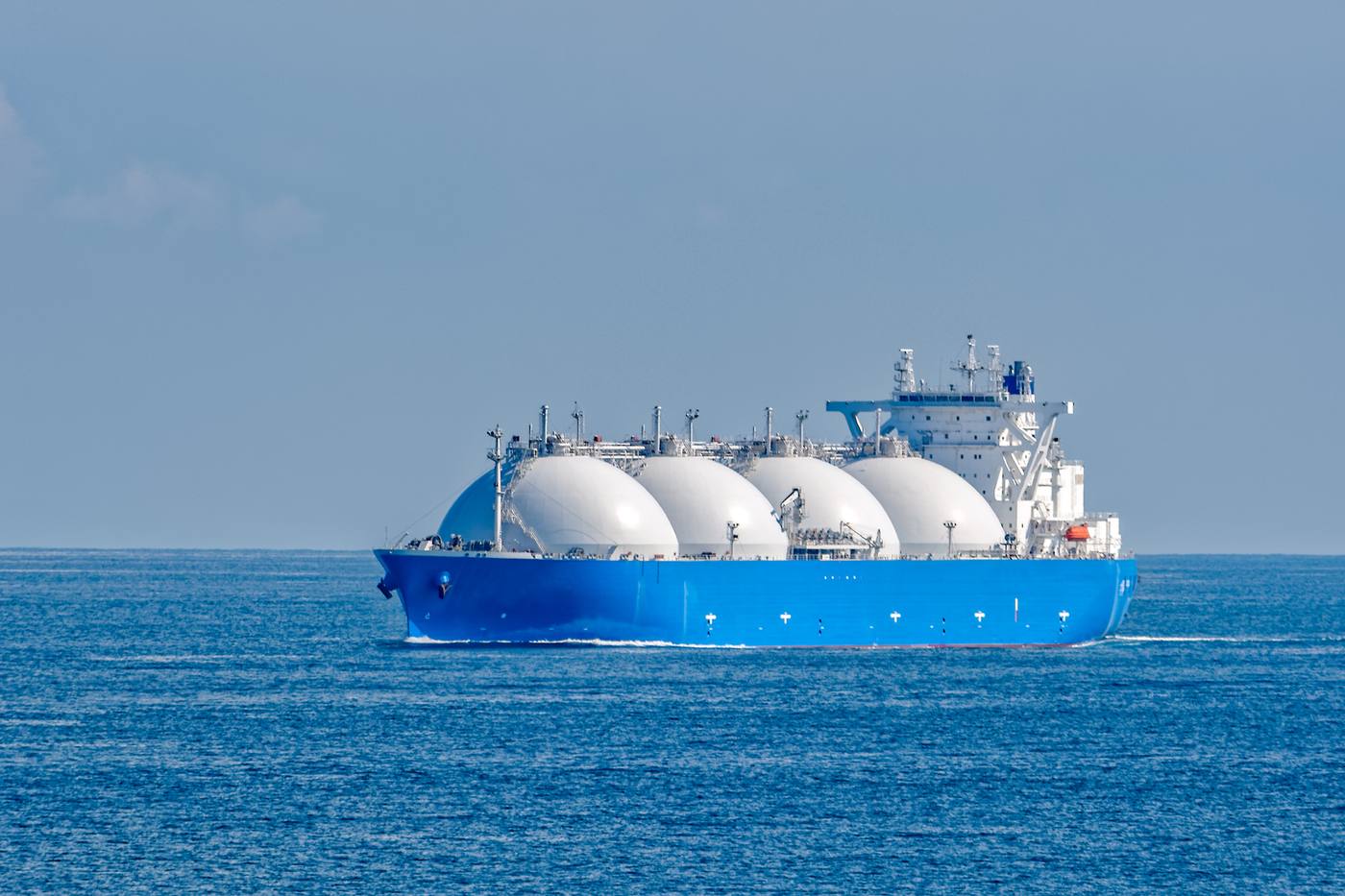
Little help can be expected from supply either. Somewhat more liquefied gas is arriving in Europe by ship again, up from about 250 to 330 million cubic metres per day since July. But the first cargoes from Qatar sailing through the Strait of Hormuz again have already been sold to Asian buyers on long-term contracts, so they will not come ashore here.
There is one supplier delivering to Europe in volume, and remarkably enough it is Russia. In the first six months of this year, over 97 percent of all liquefied gas from Yamal, the large Russian export project, arrived in European ports: almost 10 million tonnes, for which an estimated 6 billion euros was paid. European buyers are stocking up before the import ban on Russian gas takes full effect next year. You can see it here too: of the twelve tankers that docked in the Netherlands in July, two came from Russia.
Then there is Norway, and for us that weighs heaviest. Most of the gas flowing to north-west Europe through pipelines comes from Norway, and production at two offshore gas fields there is partly down. At the larger of the two, Ormen Lange, the repair is taking longer than planned, into February, so into the middle of winter. That removes more than a billion cubic metres of gas that would normally be delivered this winter. At the second field, Dvalin, 5.4 million cubic metres per day dropped out unexpectedly.
Add it all up and the exchange price for gas in north-west Europe is back above 60 euros per megawatt hour, after a dip towards 55 in early August when the market was still counting on a deal over the Strait of Hormuz.
On Wednesday 12 August the moon slid in front of the sun. In the Netherlands, almost ninety percent of the sunlight disappeared at the deepest point, around ten past eight in the evening. So the country's solar panels largely fell still, at a moment when it was already getting dark.
That showed clearly in the price. Electricity is traded a day ahead per quarter hour on the exchange, and the quarter hour at a quarter to eight cost 46 cents per kilowatt hour that evening, for the electricity alone, without tax and grid costs. Earlier that same day the price had been negative for thirteen quarter hours around midday, because there was too much sun then.
The electricity price per quarter hour on 12 and 13 August, in euros per megawatt hour. The evening of the solar eclipse is the blue line, the day after the red one. The day after was more expensive.
And that is the point. On 13 August, with no eclipse, the same quarter hour at a quarter to eight cost 49 cents per kilowatt hour. More expensive, then, than on the evening the whole country was watching. It is not the moon that sets that price, but the moment the sun goes down while everyone is still cooking, washing and working. The eclipse was just a clearly visible example of it.
Across the month, electricity is clearly more expensive than in July: an average of 12.6 cents per kilowatt hour over the first eighteen days of August, against 10.6 cents in July. There are no fewer cheap moments than in July, as the number of negative quarter hours has stayed about the same. It is the evenings that have become more expensive. And this week even that cheap midday was gone: on 17 August the cheapest quarter hour of the whole day was still 13 cents.
This is not advice for your business, every situation differs too much for that. They are, though, the four points that now shape almost every conversation we have with a business owner.
Whether it ends up at 64, 67 or 74 percent on 1 November, you will not notice it in a fine but in the price once the cold sets in. In your budget for the first quarter, allow for a winter in which gas turns out more expensive than today's prices suggest.
The market turned twice in ten days: first down because a deal over the Strait of Hormuz seemed close, then up again when it did not come. Whoever still has their entire winter volume open is betting on one morning's news. Buying in steps almost never gets you the very lowest price, but it does get you a price that will not keep you awake at night.
With evenings at 46 and 49 cents per kilowatt hour, and middays when the price dips below zero, the difference between seven in the evening and three in the afternoon starts to count for more than the difference between contract types. If you can shift cooling, charging or a production step by a few hours, that is now worth real money.
At these prices, an error in a tariff, in grid costs or in energy tax hits harder than in a normal year. We check invoices as standard and recover overpaid amounts.
Dutch gas storage is not even half full, while in ten weeks it should be at three quarters. Refilling slows down week after week, not because the installations cannot cope but because filling currently costs money instead of earning it. At the same time, Norwegian gas is out until February and the first cargoes from Qatar are going to Asia. So count on storage being thinner this winter than agreed, buy your gas in steps and watch the times at which you use electricity. This year there is more difference in that than in the type of contract you have.
Subscribe to our newsletter and never miss important news from the energy market.
We use your email address only for our newsletter and market updates. See our privacy statement.
We are happy to go through your energy situation with you and show you where the opportunities are. Free of charge and with no obligation.